


Freshwater Pom Pom Crab (Ptychognathus barbatus)
- In stock, ready to ship
- Backordered, shipping soon
⚠️ Important Legal Note: All aquatic invertebrates are prohibited to possess in any form or sell in the state of Maine. Please check your local regulations before purchasing. We are unable to ship livestock from this listing to Maine. If you reside in Maine and try to checkout with this in your cart you will be unable to checkout and receive an error message until it is removed from the cart.
Species Description
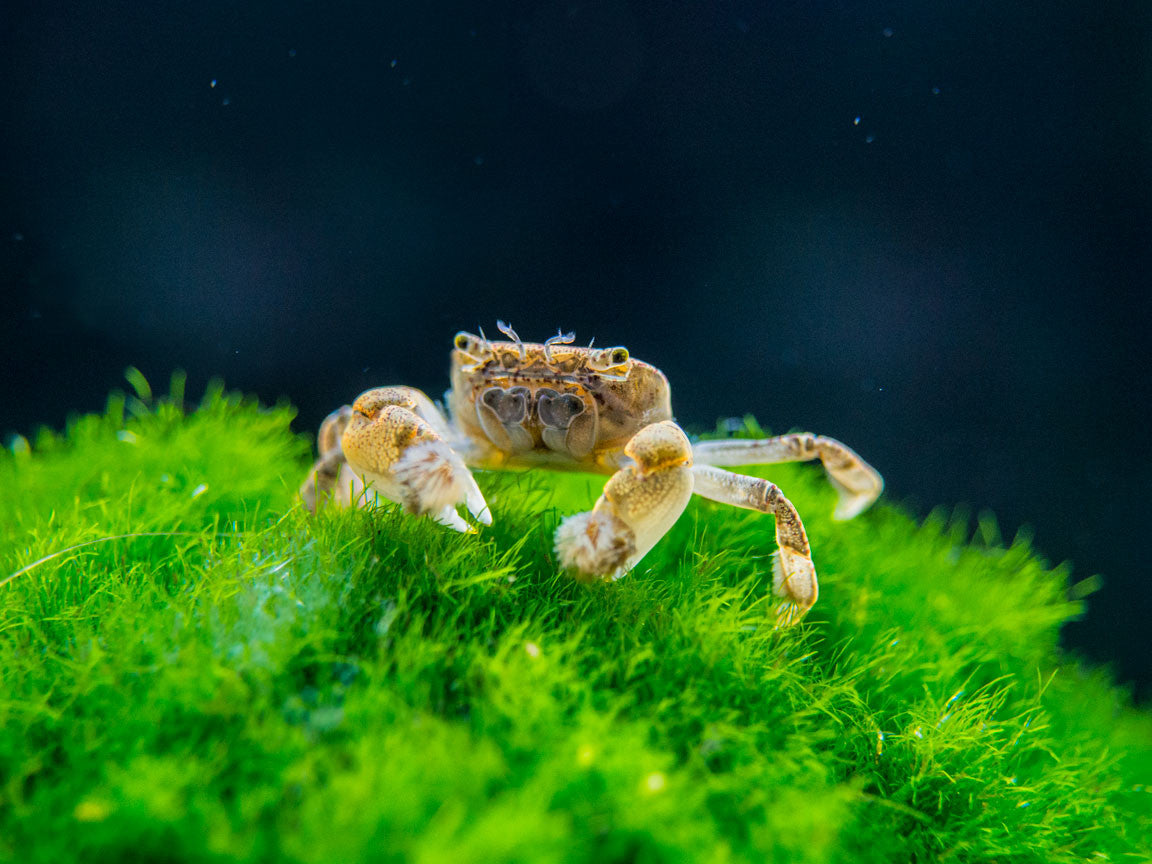
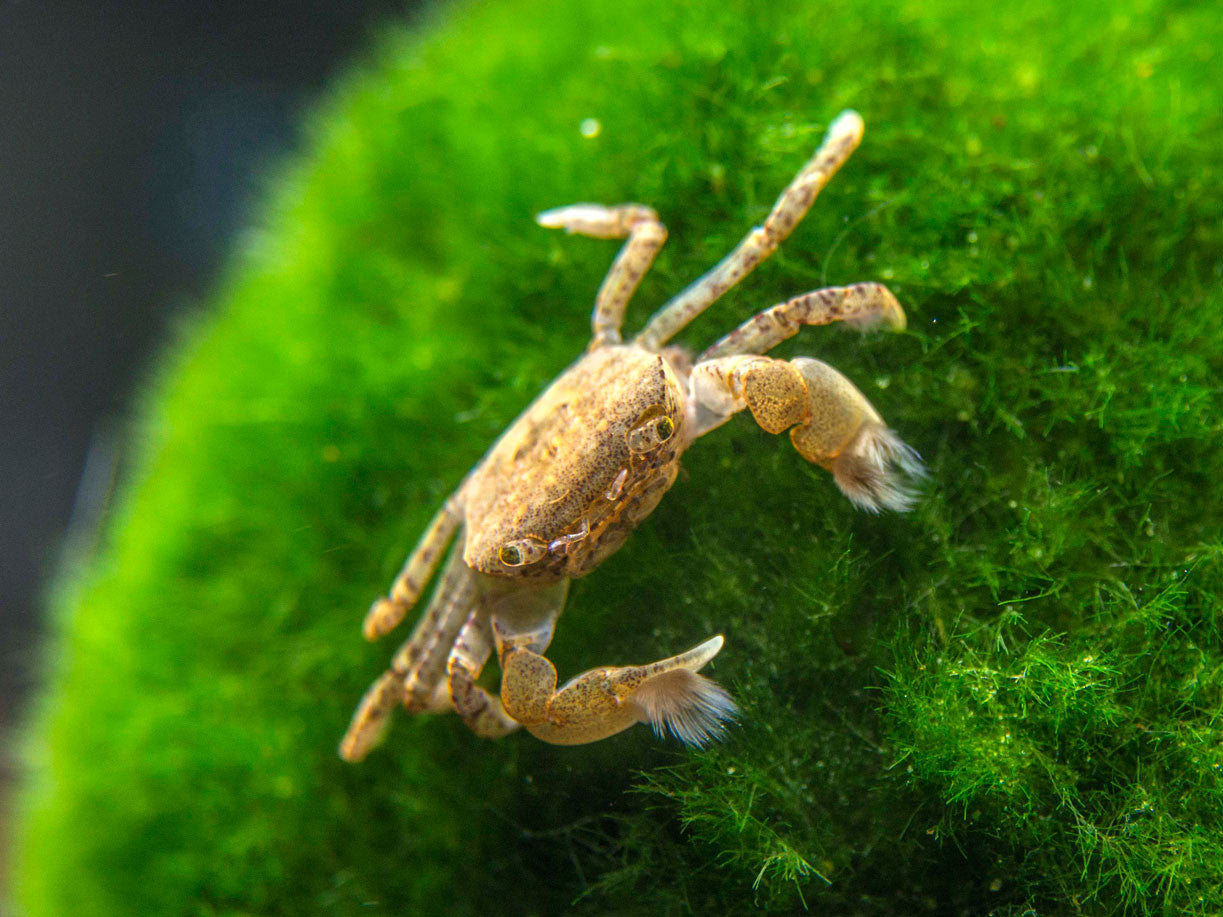
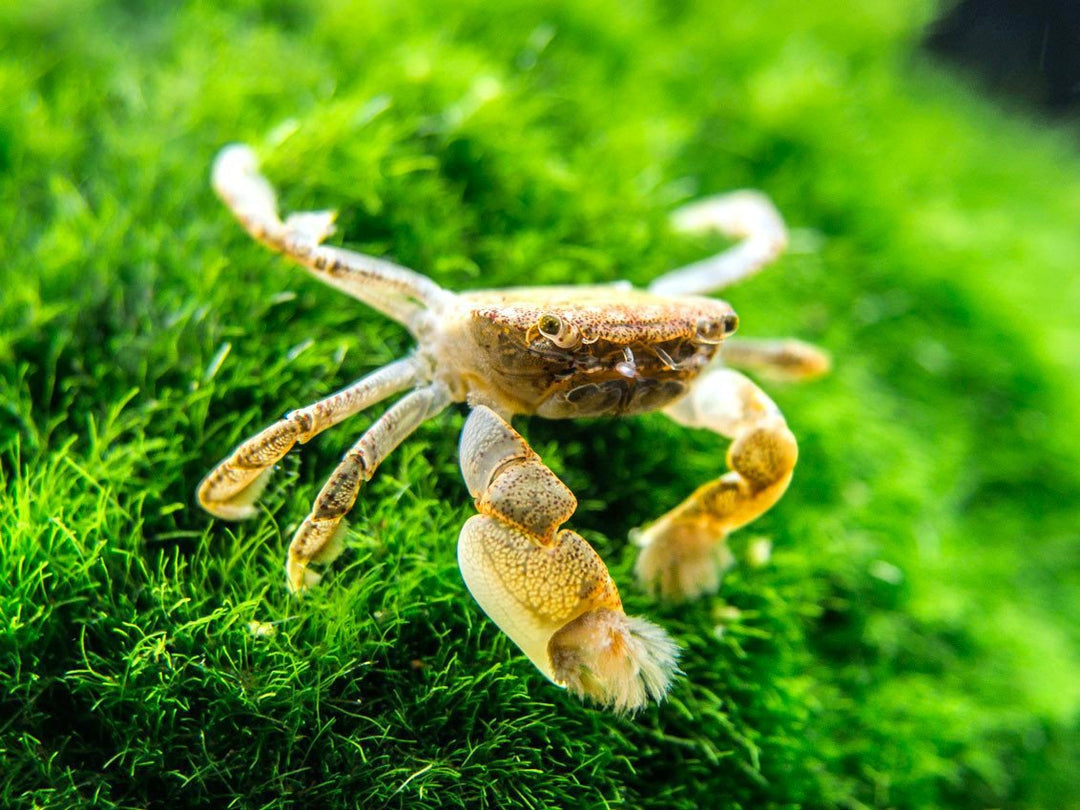
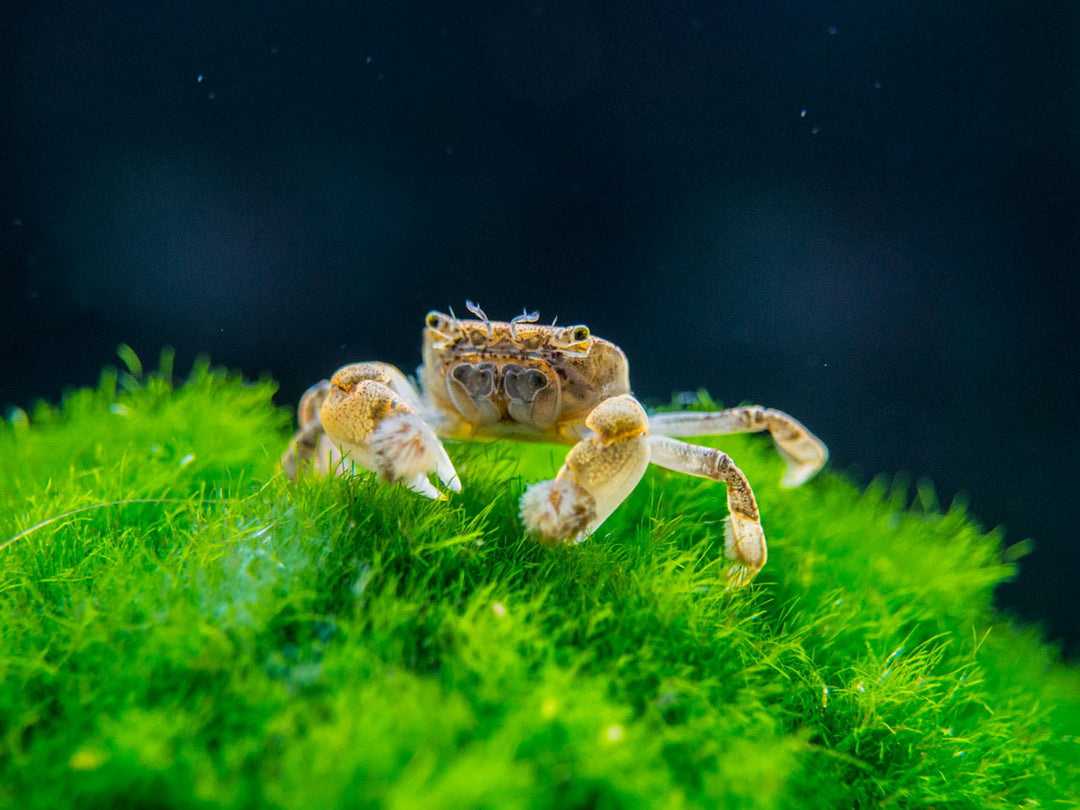
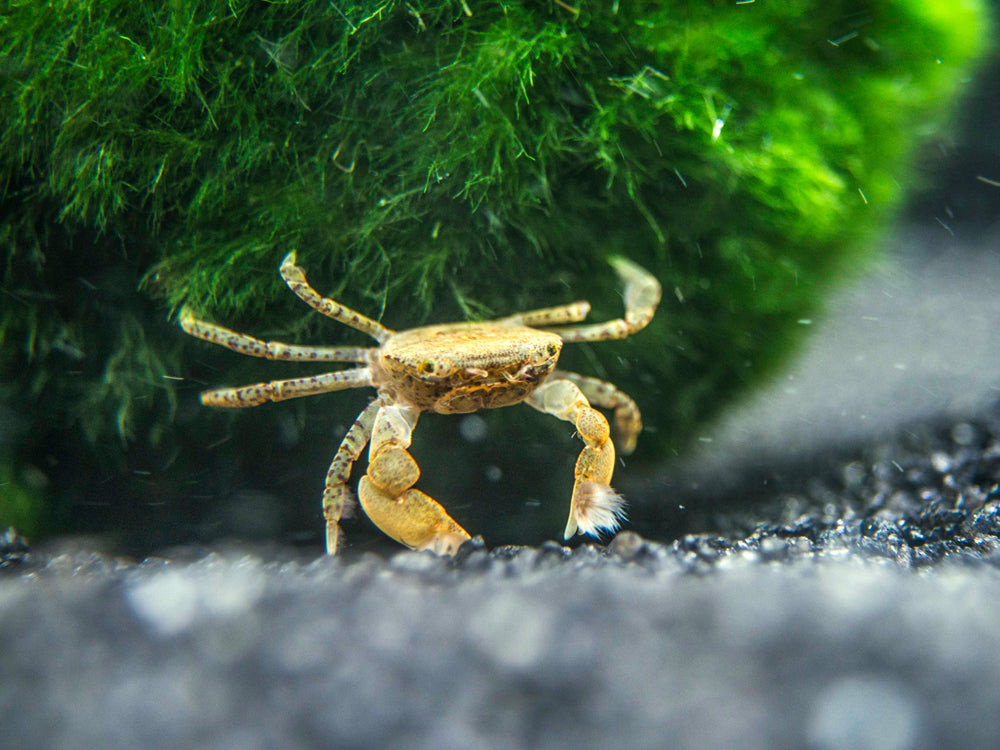
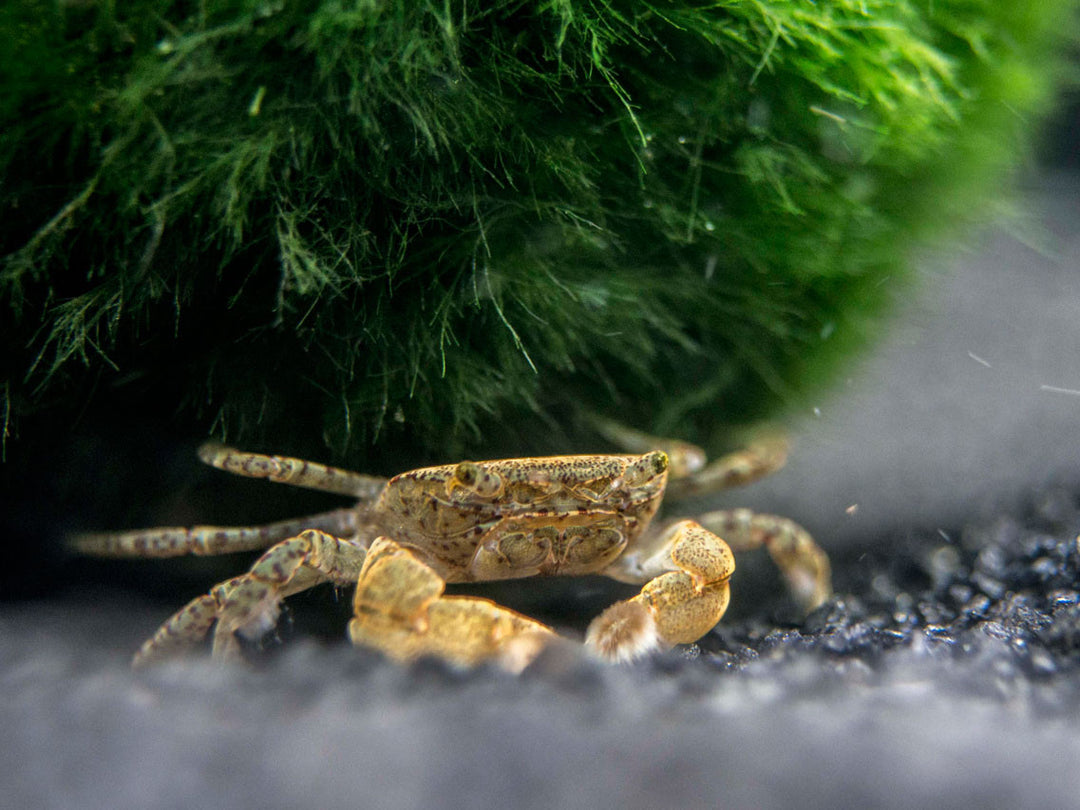
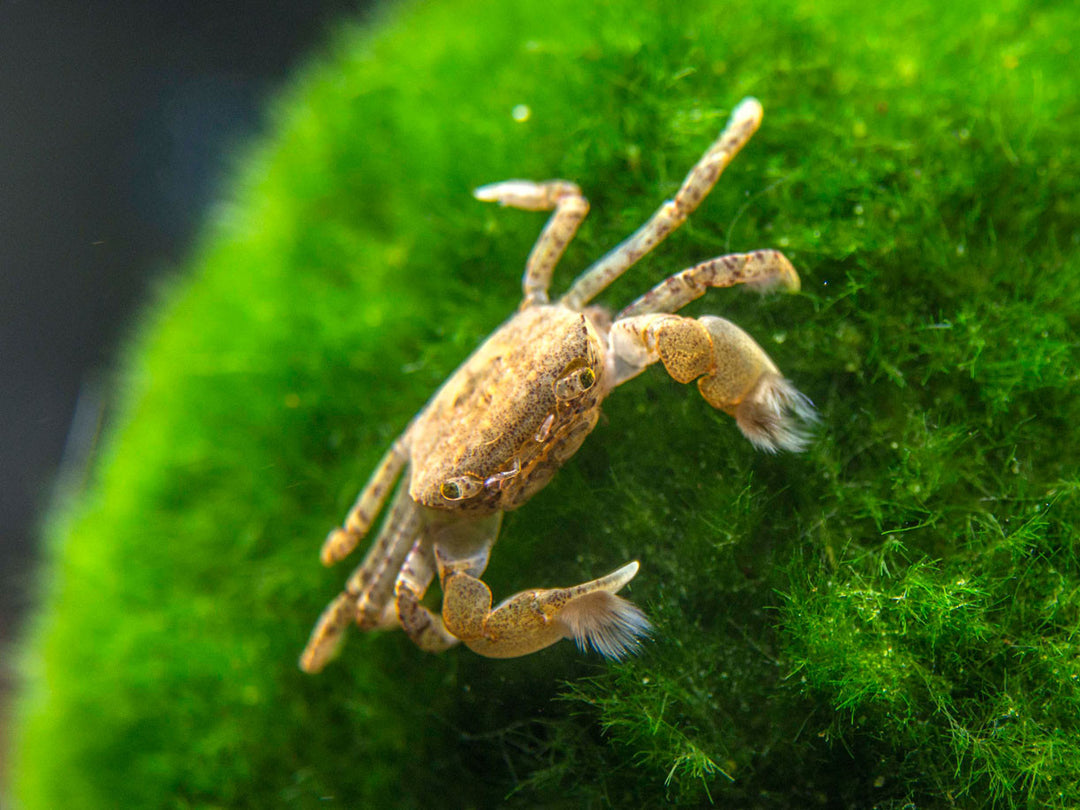
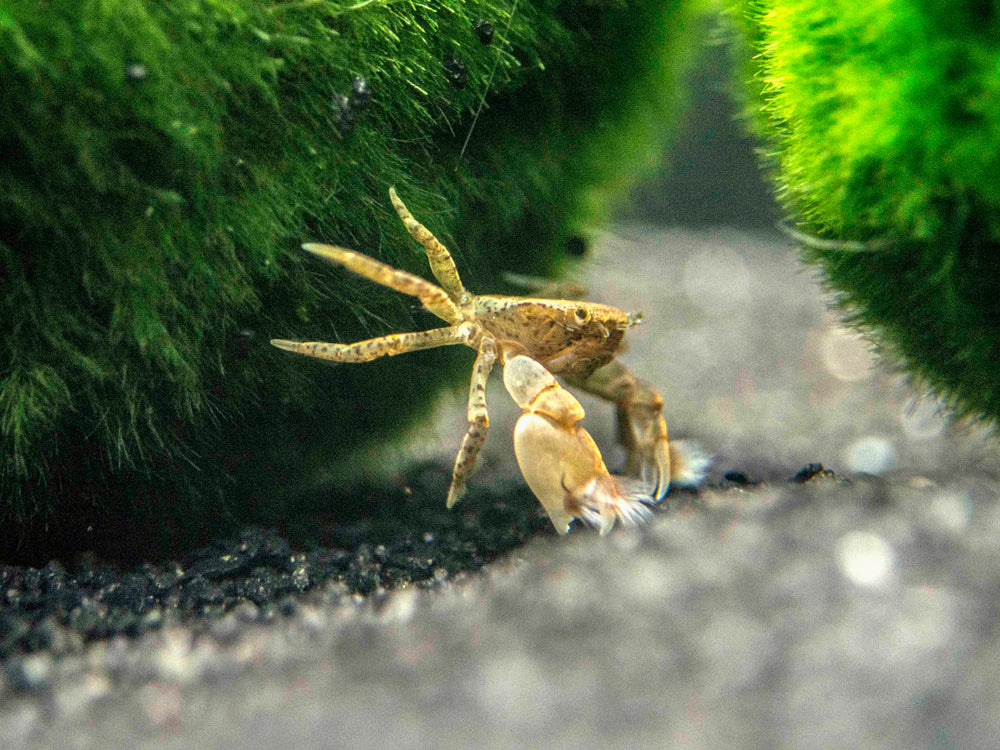
The Pom Pom Crab is a tiny, fully aquatic crab best known for the distinctive tufts of fine setae covering portions of its claws. These fuzzy “pom-poms” give the crab its common name, but they are more than decoration. The crab uses them while feeding and foraging, collecting fine food particles and organic material as it explores its surroundings.
Pom Pom Crabs spend much of their time moving across substrate, plants, rocks, driftwood, and other surfaces in search of food. Their small size and constant activity make them especially interesting in a mature, structured aquarium where biofilm, microorganisms, and other natural foods have had time to develop. They are fully aquatic and do not require a terrestrial or above-water area.
Aquarium-trade Pom Pom Crabs have traditionally been identified as Ptychognathus barbatus. More recent taxonomic research has shown that identification within this genus is considerably more complicated than previously understood, with some populations historically identified as P. barbatus now recognized as different species. For this reason, Aquatic Arts uses Ptychognathus cf. barbatus as a more cautious identification for the aquarium-trade animals we offer unless their exact species identity can be independently confirmed.
Their natural habitat also deserves some clarification. Ptychognathus crabs are strongly associated with freshwater-influenced estuarine and brackish environments, although freshwater occurrence has also been reported. Aquatic Arts has successfully maintained the Pom Pom Crabs we receive fully submerged in freshwater, but that experience alone does not establish freshwater as the optimal environment throughout the animal's entire lifespan.
For aquarists seeking the more conservative long-term approach, we recommend stable, low-end brackish conditions while the long-term salinity requirements and exact identity of aquarium-trade Pom Pom Crabs remain uncertain. We would rather be transparent about that uncertainty than present these animals as strictly freshwater crabs when the available information does not justify such a definitive claim.
Standard Grade & B-Grade Pom Pom Crabs
Aquatic Arts may offer both Standard Grade and B-Grade Pom Pom Crabs, depending on availability.
Our B-Grade crabs are animals that we consider healthy and viable but that do not meet our normal cosmetic standards for the standard grade. This is most commonly due to a missing or damaged leg or claw or another visible physical imperfection.
Crabs can regenerate lost appendages through subsequent molts, although regeneration takes time and may require multiple molts. Because the rate of regeneration varies from crab to crab, we cannot guarantee when or how completely an appendage will return.
B-Grade crabs are offered at a reduced price because of their appearance at the time of sale. B-Grade does not mean that we knowingly sell sick or unhealthy animals.
What We Love About This Crab
- Unmistakable fuzzy “pom-pom” claws make their feeding and foraging behavior fascinating to observe.
- Tiny adult size allows them to explore plants, wood, rocks, and intricate areas of a mature aquascape.
- Constant natural foraging behavior makes them particularly interesting in established aquariums rich in biofilm and natural surfaces.
- Fully aquatic lifestyle means they can be maintained without constructing a terrestrial section.
Quick Care Guide
Scientific Name: Ptychognathus cf. barbatus
Common Name: Pom Pom Crab
Family: Varunidae
Care Level: Intermediate
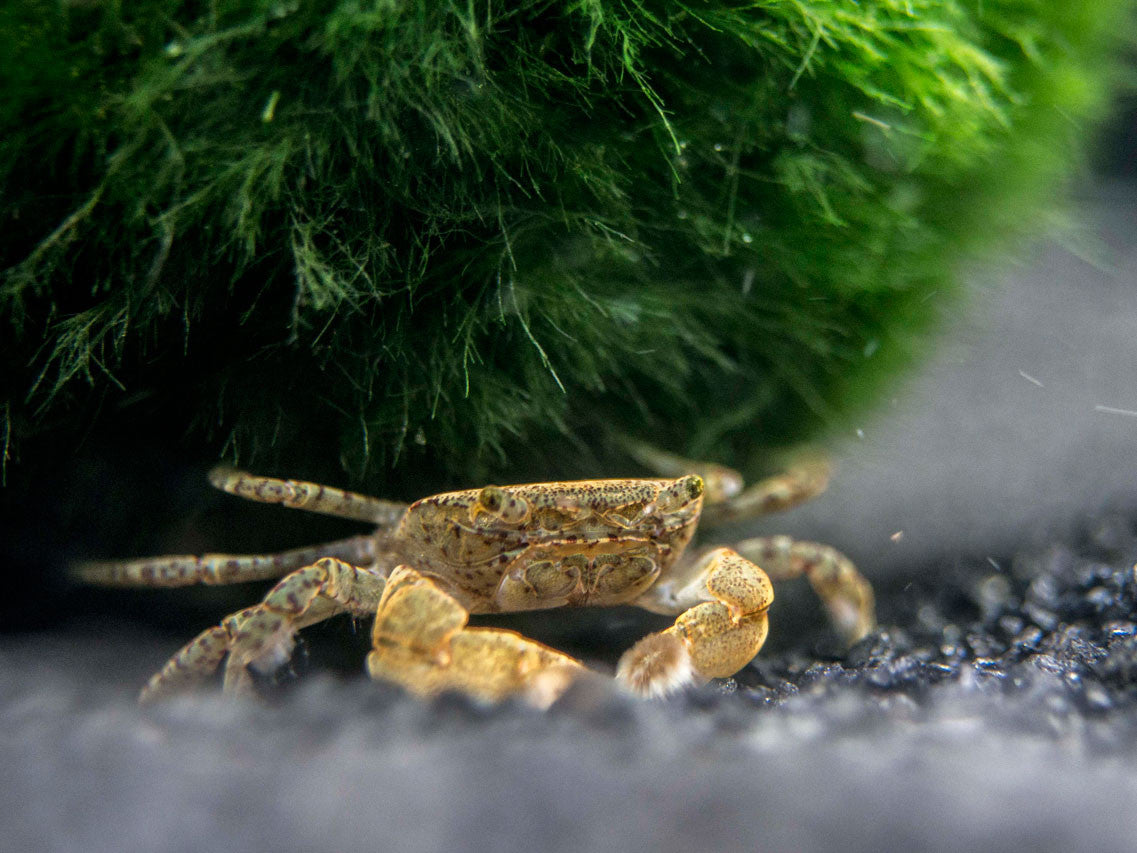
Adult Size: Approximately 1 inch across the carapace
Temperament: Generally peaceful but opportunistic
Lifestyle: Fully aquatic
Land Area Required: No
Minimum Aquarium Size: 5 gallons or larger; additional space recommended for groups
Temperature: Approximately 72–78°F (22–26°C)
Diet: Omnivorous; biofilm, fine organic material, algae, small meaty foods, and quality prepared foods
Water Movement: Gentle to moderate with good oxygenation
Aquarium: Mature aquarium with abundant structure, hiding areas, and natural surfaces
Plants: Recommended
Secure Lid: Strongly recommended
Salinity: Freshwater occurrence and successful freshwater maintenance have been documented, including in Aquatic Arts' own systems. However, because Ptychognathus is strongly associated with freshwater-influenced estuarine and brackish habitats, Aquatic Arts recommends stable low-end brackish conditions as the more conservative long-term approach.
Water Parameters
Is the Pom Pom Crab Freshwater or Brackish?
This question deserves more explanation than a simple “freshwater” or “brackish” label.
Members of Ptychognathus are strongly associated with coastal, estuarine, and other environments influenced by both freshwater and saltwater. Freshwater occurrence has also been reported, and Aquatic Arts has maintained the Pom Pom Crabs we receive in fully aquatic freshwater systems.
What we cannot currently establish is that permanent freshwater conditions are optimal throughout the entire lifespan of every Pom Pom Crab entering the aquarium trade. We also have not found reliable evidence supporting claims that these crabs can survive only a particular number of weeks or months in freshwater.
Because of that uncertainty, Aquatic Arts recommends low-end brackish conditions as the more conservative choice for long-term husbandry. This recommendation reflects what is known about the natural environments associated with the genus without making unsupported claims about how long an individual crab will survive under a particular salinity.
Salinity
If you choose to maintain your Pom Pom Crab under brackish conditions, use a marine aquarium salt mix rather than freshwater “aquarium salt,” table salt, or another sodium-chloride-only product. Brackish water should be prepared and measured rather than created by adding an arbitrary amount of salt directly to the aquarium.
We are intentionally not publishing a narrow specific-gravity requirement at this time. The exact identity of aquarium-trade Pom Pom Crabs and their optimal long-term salinity remain uncertain, and we do not want to turn a generalized recommendation from another species or population into a precise requirement for these animals without sufficient evidence.
Whatever conditions are chosen, prioritize stability. Avoid repeatedly moving the crab between freshwater and brackish conditions or making sudden changes in salinity.
Temperature
Maintain a stable temperature of approximately 72–78°F (22–26°C). Good oxygenation and consistent water quality are more important than attempting to maintain the aquarium at one exact temperature within this range.
pH and Hardness
Avoid extremely soft, acidic conditions. Like other crustaceans, Pom Pom Crabs depend on adequate dissolved minerals to support normal exoskeleton development and successful molting.
Rather than chasing a single exact pH, provide stable, appropriately mineralized water with measurable hardness and alkalinity. Any changes to hardness, pH, or salinity should be made gradually.
Aquatic Arts Husbandry Note
We maintain the Pom Pom Crabs we receive in fully aquatic freshwater systems, and we believe our direct experience with these animals is important information for customers.
At the same time, successful maintenance in our holding and conditioning systems does not prove that freshwater provides optimal conditions throughout the animal's entire natural lifespan. Current habitat and taxonomic information surrounding Ptychognathus warrants a more cautious long-term recommendation.
The freshwater-versus-brackish discussion should also not be confused with whether these crabs require access to land. Pom Pom Crabs are fully aquatic and do not require a terrestrial area.
Pom Pom Crabs in the genus Ptychognathus are associated primarily with tropical coastal and estuarine environments where freshwater meets or is influenced by saltwater. These habitats can include shallow streams near the coast, river mouths, estuaries, and areas with rocks, gravel, plant material, and accumulated organic matter. Because freshwater input and tidal influence can change throughout these environments, conditions may not remain at one fixed salinity.
These habitats also help explain much of the Pom Pom Crab's behavior in the aquarium. Rather than spending its time swimming through open water, this small crab is adapted to moving across and between surfaces while searching for food. Rocks, gravel, wood, plant material, and other submerged structure provide places to forage as well as protected spaces where the crab can retreat.
Organic material is an important part of this environment. Leaves, plant debris, algae, microorganisms, and other material create productive surfaces where biofilm and small food particles accumulate. In the aquarium, recreating that structural and biological complexity is more useful than trying to create a bare tank with perfectly clean surfaces.
Because the exact identity of aquarium-trade Pom Pom Crabs remains uncertain, we should be careful about describing one narrowly defined locality as the natural habitat of every crab sold under the Ptychognathus barbatus name. What we can recreate with greater confidence is the type of environment associated with the genus: fully aquatic, highly structured, well oxygenated, rich in natural foraging surfaces, and influenced by freshwater and brackish conditions.
What This Means for the Aquarium
A good Pom Pom Crab aquarium should therefore provide more than the correct water parameters. It should give the crab an environment it can actually use. Rockwork, driftwood, plants, botanicals, and other textured surfaces create places for biofilm to develop while also giving these tiny crabs protected spaces to explore and hide.
That becomes especially important during molting. A freshly molted crab is soft and vulnerable, so small crevices and dense areas of cover allow it to remain hidden while its new exoskeleton hardens.
Unlike Vampire Crabs and other semi-terrestrial species, Pom Pom Crabs do not need a land section or paludarium-style setup. The habitat recreation should remain fully aquatic.
The best Pom Pom Crab aquascape isn't necessarily a perfectly manicured display. These crabs benefit from an aquarium with layers of structure, mature surfaces, and small protected spaces that they can explore throughout the day.
Driftwood
Driftwood is an excellent foundation for a Pom Pom Crab aquarium. Its irregular surface creates additional grazing area for biofilm while branches and spaces beneath the wood provide cover.
Pieces with complex shapes are especially useful because these tiny crabs can move through spaces that larger aquarium inhabitants cannot. Allowing some natural biofilm to remain on the wood gives the crab additional opportunities to forage rather than keeping every surface spotless.
Rocks and Crevices
Use rocks to create small caves, gaps, and protected areas throughout the aquarium. The goal isn't to build one large cave but to provide numerous little retreats where the crab can disappear when it feels threatened or prepares to molt.
Make sure rockwork is stable. Crabs will investigate underneath objects, so heavy stones should be positioned securely rather than balanced where digging or movement could cause them to shift.
Pom Pom Crabs are omnivorous, opportunistic foragers that spend much of their time searching the aquarium for small edible material. A mature aquarium provides an important part of their diet through biofilm, microorganisms, algae, detritus, and fine organic particles, but these naturally occurring foods should supplement rather than replace deliberate feeding.
Their distinctive fuzzy claws are one of the most interesting parts of their feeding behavior. The fine setae that create the crab's “pom-poms” help collect small food particles as the crab moves through the aquarium. You may see the crab repeatedly bringing its claws toward its mouth as it works through material it has gathered.
Are Pom Pom Crabs Filter Feeders?
Pom Pom Crabs can collect fine suspended food particles with the setae on their claws, so their feeding behavior can resemble filter feeding. However, describing them simply as filter feeders gives an incomplete picture of how they obtain food.
They are active foragers. They move across substrate, plants, wood, rocks, and other surfaces, picking through biofilm and organic material while also taking appropriately sized prepared and meaty foods. They should not be maintained with the expectation that filtration currents will provide everything they need.
What Should I Feed My Pom Pom Crab?
Offer a varied diet rather than relying on one food. Appropriate choices can include:
Fine or crushed quality shrimp and crustacean foods
Small sinking pellets or wafers
Frozen foods such as finely portioned bloodworms, brine shrimp, or similar appropriately sized foods
Naturally occurring biofilm and algae
Small amounts of other quality omnivore foods that soften enough for the crab to manipulate and eat
Because these crabs are tiny, portion size matters. A food item that seems small to us can still be enormous relative to a Pom Pom Crab. Crushing or breaking foods into smaller pieces gives the crab more opportunities to feed while reducing the amount of uneaten food left to decay.
Feeding in a Mature Aquarium
A mature aquarium is particularly valuable for Pom Pom Crabs because feeding doesn't occur only when food is dropped into the tank. Established wood, rocks, plants, botanicals, substrate, and even a sponge pre-filter can support biofilm and microorganisms that give the crab something to investigate throughout the day.
This is one reason we prefer a biologically mature aquarium over a newly assembled sterile setup. The goal isn't a dirty aquarium; it's an aquarium with healthy biological activity and mature surfaces.
How Often Should I Feed?
Offer small amounts regularly and watch how quickly the food is consumed. In an established aquarium with abundant natural grazing opportunities, supplemental feeding can be modest, but the crab should still receive intentional nutrition.
Rather than following a rigid amount based solely on aquarium size, observe the animals. Food should be accessible long enough for these small crabs to find it without leaving large quantities decomposing in the aquarium.
If fish or shrimp are also present, make sure the Pom Pom Crab is actually getting food. Faster tank mates can consume sinking foods before a small crab has an opportunity to reach them.
Feeding During and After Molting
Nutrition becomes particularly important around the molting cycle. Crustaceans need adequate protein, minerals, and overall nutrition to grow and rebuild their exoskeleton successfully.
If you find an empty molt, don't automatically remove it. The crab may consume portions of its old exoskeleton, allowing it to reclaim minerals and other material. Leaving the molt temporarily is generally preferable unless it begins creating a water-quality problem.
A freshly molted crab may disappear into a crevice and stop appearing at normal feeding times. This can be completely normal. Avoid disturbing hiding places trying to find it; the crab is especially vulnerable while its new exoskeleton hardens.
Are Pom Pom Crabs Algae Eaters?
They may graze algae while foraging, but Pom Pom Crabs should not be purchased primarily for algae control. Their small size means they cannot replace normal aquarium maintenance or a dedicated algae-management strategy.
Algae is simply one component of the diverse material they encounter while grazing.
Do Pom Pom Crabs Eat Fish Waste?
Pom Pom Crabs may investigate decomposing organic material, but they should not be thought of as animals that “eat poop” or eliminate aquarium waste.
Waste still needs to be processed by the aquarium's biological filtration or physically removed through normal maintenance. Adding a Pom Pom Crab doesn't reduce the aquarium's overall biological load.
Can I Feed Them Only Leftovers From My Fish?
I wouldn't rely on leftovers alone. In a community aquarium, it can be difficult to know whether the crab is receiving enough food or simply finding whatever the other animals missed.
Providing small sinking foods in areas the crab frequents gives you a better opportunity to make sure it receives a varied diet.
Target Feeding
Target feeding can be helpful, particularly in aquariums containing fast-moving fish or large numbers of shrimp. Small pieces of food can be placed near the crab's preferred hiding or foraging area with feeding tongs or a pipette, depending on the food being offered.
You don't necessarily need to put food directly in front of the crab every time. The objective is simply to make sure some food reaches areas where the crab can find it before faster animals consume everything.
A Healthy Aquarium Is Part of the Diet
With Pom Pom Crabs, feeding and aquascaping are closely connected. Plants, mosses, wood, rocks, botanicals, and mature filter media aren't just decoration—they create feeding surfaces.
A good Pom Pom Crab aquarium therefore provides both deliberate supplemental foods and a mature environment where the crab can spend the rest of its time doing what comes naturally: exploring and foraging.
Pom Pom Crabs are small and generally peaceful, making them suitable for carefully selected community aquariums. Their tiny size means the bigger concern is often protecting the crab from its tank mates, rather than worrying about the crab attacking healthy adult fish.
Choose peaceful species that are unlikely to harass, pick at, or attempt to eat the crab. This becomes especially important during molting, when a Pom Pom Crab's new exoskeleton is still soft and the crab is particularly vulnerable. Plenty of rockwork, plants, driftwood, and small crevices allow the crab to retreat completely from other aquarium inhabitants when necessary.
Good Tank Mate Characteristics
Look for animals that are:
Peaceful and unlikely to hunt small crustaceans
Small enough that a Pom Pom Crab isn't viewed as potential prey
Unlikely to compete aggressively for sinking foods
Compatible with the water conditions being maintained
Small, peaceful schooling fish can be appropriate, provided their water requirements overlap with those of the crab. Avoid assuming that a fish is compatible simply because it is labeled a “community fish”; feeding behavior and interest in small crustaceans matter too.
Tank Mates to Avoid
Avoid large, aggressive, or strongly predatory fish and other animals likely to investigate a small crab as food. Puffers, larger cichlids, many predatory bottom dwellers, and aggressive crustaceans would not be appropriate choices.
I would also avoid housing Pom Pom Crabs with larger crayfish or territorial crabs. Even if the animals don't actively hunt one another, the size difference and vulnerability of a freshly molted Pom Pom Crab creates unnecessary risk.
Keeping Multiple Pom Pom Crabs
Multiple Pom Pom Crabs can be maintained together when the aquarium provides sufficient space, food, and hiding areas. Rather than creating one central cave, provide numerous small retreats throughout the aquarium so individuals aren't forced to compete for the same protected space.
An established aquarium also helps reduce competition by providing more natural foraging opportunities across plants, wood, rocks, substrate, and other mature surfaces.
Don't Forget About Feeding Competition
Compatibility isn't only about whether one animal attacks another. Pom Pom Crabs are tiny and can easily be outcompeted by faster fish at feeding time.
In a community aquarium, watch to make sure food actually reaches the crab. Placing small sinking foods near its preferred foraging areas or occasionally target feeding can help ensure it receives adequate nutrition.
Water Chemistry Matters Too
Because we're taking a more conservative approach to the freshwater/brackish question, behavioral compatibility alone isn't enough to make something a good tank mate.
If the Pom Pom Crab is being maintained under low-end brackish conditions, every animal and plant sharing the aquarium must also tolerate those conditions. A species that makes an excellent companion behaviorally may still be an inappropriate tank mate if it requires strictly freshwater conditions.
Pom Pom Crabs can generally coexist with shrimp, but we would not describe any crab as completely shrimp safe. They are tiny, relatively peaceful omnivores rather than active shrimp hunters, but they are still opportunistic crustaceans capable of taking advantage of food when the opportunity presents itself.
Healthy adult shrimp are unlikely to be viewed as normal prey, particularly in a mature, heavily structured aquarium. Adult Neocaridina, Caridina, and Amano Shrimp are generally mobile enough to move away from a Pom Pom Crab, and the two can spend much of their time foraging on the same surfaces without interacting significantly.
What About Baby Shrimp?
Shrimplets deserve more caution. Newly hatched shrimp are extremely small, and we cannot guarantee that a Pom Pom Crab will never capture or consume one it encounters.
In a well-established shrimp colony with dense moss, plants, rockwork, wood, and other cover, occasional losses may have little effect on the overall population. However, if your primary goal is to maximize the survival of every shrimplet, keeping any opportunistic crab in the same aquarium introduces some additional risk.
Molting Shrimp
A freshly molted shrimp is soft, vulnerable, and less capable of escaping than it normally would be. A Pom Pom Crab encountering a vulnerable shrimp could potentially investigate or take advantage of the opportunity.
This is another reason dense structure and numerous hiding areas are important when keeping shrimp and Pom Pom Crabs together. Shrimp naturally seek protected areas during and immediately after molting, and the aquarium should provide enough cover for them to disappear when necessary.
Will Pom Pom Crabs Compete With Shrimp for Food?
Yes, although this isn't necessarily a problem. Both animals spend considerable time grazing biofilm and investigating surfaces for edible material, and both may be attracted to sinking shrimp foods.
In a mature aquarium, wood, rocks, mosses, plants, botanicals, and other surfaces provide many separate foraging areas. When supplemental food is offered, distributing small portions in more than one location can also prevent every animal from concentrating around a single piece of food.
Can Pom Pom Crabs Live in a Shrimp Aquarium?
They can be an interesting addition to an established shrimp aquarium when the aquarist accepts that “compatible with shrimp” does not mean zero risk to every individual shrimp or shrimplet.
There is also an important water-chemistry consideration. If the Pom Pom Crab is maintained under the low-end brackish conditions we recommend as the more conservative long-term approach, the shrimp species sharing the aquarium must tolerate the same salinity. Many popular freshwater dwarf shrimp are maintained in freshwater and should not automatically be assumed to be appropriate companions simply because the animals are behaviorally compatible.
For a dedicated freshwater breeding colony where maximizing shrimplet production is the priority, we would keep the shrimp separately rather than introduce another opportunistic crustacean.
Shrimp Safety Rating: Generally compatible with healthy adult shrimp, but not guaranteed safe with shrimplets or vulnerable molting shrimp.
Breeding Pom Pom Crabs in the home aquarium is considerably more complicated than keeping the adults. Although mature crabs may reproduce in captivity, the presence of eggs does not mean that a self-sustaining population will develop in a normal aquarium.
Females may carry eggs beneath the abdomen, where they are protected until they hatch. Unlike freshwater dwarf shrimp, however, the young do not simply hatch as miniature versions of the adults ready to begin living on the substrate.
Do Pom Pom Crabs Reproduce in Freshwater?
We would not expect successful completion of the full reproductive cycle in a typical freshwater aquarium.
Members of Ptychognathus have planktonic larval development, meaning newly hatched larvae must pass through developmental stages before becoming juvenile crabs. This is very different from Neocaridina shrimp, whose young hatch looking essentially like tiny shrimp.
The natural association of these crabs with estuarine environments is especially important here. Salinity can play an important role during larval development in crabs whose life cycles are connected to estuaries and coastal waters.
Can a Female Carry Eggs in an Aquarium?
Yes. A female carrying eggs does not necessarily indicate that the aquarium provides everything required for the larvae to survive.
If you see a female with an egg mass beneath her abdomen, avoid repeatedly handling or disturbing her. Provide good water quality, adequate nutrition, and plenty of protected areas where she can remain comfortable.
What Happens When the Eggs Hatch?
The larvae are extremely small and enter the water column rather than immediately behaving like bottom-dwelling adult crabs. At that point, successfully raising them becomes a specialized breeding project involving appropriate water chemistry, microscopic or very small foods, and management of the larval environment.
A community aquarium presents additional challenges because filters and tank mates can quickly remove planktonic larvae from the system.
Can I Breed Pom Pom Crabs at Home?
Potentially, but we would consider this an advanced breeding project rather than an expected part of normal Pom Pom Crab care.
There is also an important limitation to what we can responsibly tell customers. Because the exact identity of aquarium-trade Pom Pom Crabs is uncertain, we do not want to publish a rigid breeding protocol—particularly exact salinity or larval-development requirements—based on another Ptychognathus species and present it as established husbandry for the animals we sell.
Aquarists interested in attempting captive breeding should be prepared to work with a separate larval-rearing system and carefully document salinity, temperature, feeding, development, and survival.
Why Captive Breeding Matters
Successful captive propagation would be particularly valuable for this animal. Establishing reliable aquarium-bred populations could eventually reduce dependence on collected animals while also giving aquarists a much better understanding of their complete life cycle and long-term husbandry requirements.
For now, customers should purchase Pom Pom Crabs because they want to keep and observe the adults—not with the expectation that adding males and females will automatically produce a colony.
Is the Pom Pom Crab a freshwater or brackish crab?
Pom Pom Crabs have commonly been sold in the aquarium hobby as freshwater crabs, and Aquatic Arts has successfully maintained the animals we receive fully submerged in freshwater. However, Ptychognathus is strongly associated with estuarine and freshwater-influenced brackish habitats in nature.
Because the exact identity and long-term salinity requirements of aquarium-trade Pom Pom Crabs remain uncertain, Aquatic Arts no longer considers it appropriate to describe them simply as strictly freshwater animals. For aquarists seeking the more conservative long-term approach, we recommend stable, low-end brackish conditions.
Can Pom Pom Crabs live their entire lives in freshwater?
We don't currently believe there is enough evidence to answer this definitively. Aquatic Arts has maintained these crabs successfully in freshwater, and freshwater occurrences have been reported. What we cannot establish from that experience is whether permanent freshwater provides optimal conditions throughout their maximum potential lifespan.
We have also seen claims that Pom Pom Crabs survive only weeks or months in freshwater but live for years in brackish water. We have not found sufficient evidence to support such a precise comparison, so we do not repeat those lifespan claims as established fact.
Why does Aquatic Arts recommend brackish water if you keep them in freshwater?
Our recommendation is intentionally conservative. Our direct experience demonstrates that the animals we receive can be maintained in freshwater, but our holding experience cannot establish which conditions maximize their lifespan or reproductive success.
Scientific information associates Ptychognathus strongly with freshwater-influenced estuarine and brackish environments. Until more is known about the exact aquarium-trade animals and their long-term requirements, low-end brackish conditions provide a cautious approach based on that natural history.
What salinity does a Pom Pom Crab need?
We are intentionally not providing a narrow specific-gravity requirement at this time. The identification of aquarium-trade Pom Pom Crabs and their exact long-term salinity requirements remain uncertain, and we don't want to present a precise number borrowed from another population or species as though it has been established for these animals.
If maintaining them under brackish conditions, use a proper marine aquarium salt mix and measure the resulting salinity. Stability and gradual changes are particularly important.
Can I use aquarium salt to make brackish water?
No. Freshwater aquarium salt is not the same thing as a marine salt mix. A proper marine aquarium salt mix contains a broader range of minerals and ions needed to reproduce brackish or marine water.
Do not simply add salt directly to an occupied aquarium. Prepare replacement water separately, measure its salinity, and make changes gradually.
Do Pom Pom Crabs need land?
No. Pom Pom Crabs are fully aquatic. The freshwater-versus-brackish question concerns the chemistry of the water, not whether the crab needs to leave it.
Unlike semi-terrestrial Vampire Crabs, Pom Pom Crabs do not require a paludarium or dedicated land section.
Can Pom Pom Crabs climb out of an aquarium?
They can climb surprisingly well and may use plants, equipment, cords, tubing, or hardscape to reach the upper portions of an aquarium. We strongly recommend a secure lid and checking openings around filtration equipment and cables.
Providing a lid doesn't mean the crab requires land. It simply prevents an aquatic crab from accidentally escaping its aquarium.
How large do Pom Pom Crabs get?
Pom Pom Crabs remain very small, reaching approximately 1 inch across the carapace. Their tiny size is one reason dense aquascaping works so well for them; they can explore crevices and spaces that larger crustaceans cannot use.
What do the “pom-poms” actually do?
The pom-poms are tufts of fine setae associated with the claws. They help the crab gather small food particles and organic material while it forages.
Watching the crab manipulate these fuzzy claws and repeatedly bring collected material toward its mouth is one of the most distinctive behaviors of the animal.
Are Pom Pom Crabs filter feeders?
Partially, but calling them simply filter feeders is misleading. Their setae can collect fine particles from the water, but Pom Pom Crabs also actively forage across substrate, plants, rocks, wood, and other surfaces.
They should receive supplemental food and should not be expected to survive solely on whatever particles happen to pass through the aquarium.
What should I feed a Pom Pom Crab?
Provide a varied omnivorous diet that can include finely crushed shrimp or crustacean foods, small sinking foods, appropriately sized frozen foods, and the natural biofilm, algae, microorganisms, and organic material found in a mature aquarium.
Because the crabs are tiny, offer correspondingly small portions. In community aquariums, make sure faster fish and shrimp aren't consuming everything before the crab gets an opportunity to feed.
Do Pom Pom Crabs eat algae?
They will graze algae and other material while foraging, but they should not be purchased primarily as algae-control animals. Their small size limits how much algae they can consume.
Think of algae as one part of the natural material they investigate rather than their entire diet.
Do Pom Pom Crabs eat fish waste?
They may investigate decomposing organic material, but Pom Pom Crabs do not make fish waste disappear from the aquarium. Waste still contributes nutrients and biological load to the system and must be handled through filtration and normal aquarium maintenance.
They are fascinating foragers, not a substitute for cleaning the aquarium.
How often should I feed my Pom Pom Crab?
Feed small amounts regularly while taking into account how much natural food is available in the aquarium. A mature aquarium rich in biofilm provides considerably more grazing opportunities than a newly established aquarium.
The goal is to make sure the crab receives adequate nutrition without leaving excessive food behind to decompose.
Can Pom Pom Crabs live with fish?
Yes, with carefully selected species. Choose small, peaceful fish that are unlikely to view the crab as prey or harass it while it is molting.
Avoid puffers, larger cichlids, aggressive bottom dwellers, and other animals likely to hunt or investigate small crustaceans.
Water chemistry must also overlap. If you're maintaining the crab in low-end brackish water, its fish tank mates must tolerate the same conditions.
Are Pom Pom Crabs shrimp safe?
We consider them generally compatible with healthy adult shrimp, but we would not describe any opportunistic crab as 100% shrimp safe.
Very small shrimplets and freshly molted shrimp are more vulnerable. If maximizing survival in a valuable shrimp-breeding colony is the goal, keeping the Pom Pom Crab separately is the safer choice.
Can Pom Pom Crabs live with snails?
Peaceful aquarium snails are generally more appropriate companions than predatory or aggressive animals. However, both species still need compatible water conditions, and very small or vulnerable animals can never be guaranteed completely safe around an opportunistic crab.
Can I keep more than one Pom Pom Crab?
Yes, multiple Pom Pom Crabs can be kept when sufficient space, food, and hiding places are provided. Build numerous small retreats rather than forcing all of the crabs to share one cave or protected area.
Additional structure becomes especially valuable during molting, when individuals need somewhere to remain hidden.
What size aquarium does a Pom Pom Crab need?
Their small adult size means they don't require a large aquarium simply to accommodate their body size. We recommend at least 5 gallons, with larger aquariums providing more stable water conditions and more room when keeping multiple crabs or tank mates.
A mature, structured 5-gallon aquarium is considerably more useful to a Pom Pom Crab than an equally sized bare aquarium.
Do Pom Pom Crabs need strong water flow?
No. Gentle to moderate circulation with good oxygenation is preferable.
Some movement helps distribute fine food particles and oxygen throughout the aquarium, but the crab should also have protected areas where it isn't constantly fighting a strong current.
Do Pom Pom Crabs need live plants?
Live plants aren't an absolute requirement, but we strongly recommend them. Plants create additional structure, hiding places, and surfaces where biofilm and microorganisms can develop.
If you're maintaining brackish conditions, make sure the plants you select tolerate the salinity you're using.
Why is my Pom Pom Crab hiding?
Hiding is normal behavior, particularly after introduction to a new aquarium and around molting.
These tiny crabs can disappear into surprisingly small spaces. If water conditions are good and the aquarium is secure, resist the temptation to dismantle the aquascape every time you don't see the crab.
How do I know if my Pom Pom Crab is molting or dead?
A discarded exoskeleton can look remarkably like a dead crab because it retains the shape of the entire animal. Look carefully for an opening in the shell and remember that the actual crab may be hiding nearby while its new exoskeleton hardens.
If you're uncertain, don't immediately tear apart its hiding areas looking for it. A freshly molted crab is especially vulnerable and benefits from being left undisturbed.
Should I remove the molt?
Usually not immediately. Crustaceans may consume portions of their discarded exoskeleton and recover minerals from it.
Allow the crab access to the molt unless it begins deteriorating to the point that it is creating a water-quality concern.
Do Pom Pom Crabs need calcium?
Like other crustaceans, Pom Pom Crabs need appropriate minerals to build and maintain their exoskeleton and molt successfully. This is one reason we don't recommend extremely soft, acidic, poorly mineralized water.
A varied diet and appropriately mineralized water are preferable to automatically adding calcium products without knowing the aquarium's existing water chemistry.
How long do Pom Pom Crabs live?
There isn't enough reliable information for us to promise a specific lifespan for aquarium-trade Pom Pom Crabs.
Lifespan claims become particularly difficult because the animals sold under the Pom Pom Crab name may not all represent the same Ptychognathus species. Husbandry, diet, water chemistry, salinity, maturity at purchase, and individual condition can also influence longevity.
Can Pom Pom Crabs breed in an aquarium?
Females can carry eggs, but successfully producing juvenile crabs is considerably more difficult than breeding freshwater dwarf shrimp.
The larvae pass through planktonic developmental stages rather than hatching as miniature benthic crabs. Successfully raising those larvae would require specialized conditions, food, and likely careful management of salinity.
Why are these sold as Ptychognathus cf. barbatus instead of simply Ptychognathus barbatus?
The cf. means that the animal compares closely with Ptychognathus barbatus, but that we are not claiming its exact species identity has been definitively established.
Pom Pom Crabs in the aquarium trade have traditionally been called P. barbatus. More recent taxonomic research has shown that some populations previously identified under that name actually represent other species. We believe acknowledging that uncertainty is more responsible than continuing to present the old identification as unquestionable.
What is a B-Grade Pom Pom Crab?
A B-Grade Pom Pom Crab is an animal we consider healthy and viable but that has a cosmetic or physical imperfection that prevents it from meeting our standard-grade appearance criteria. This may include a missing or damaged leg or claw.
We offer these animals at a reduced price because of their condition at the time of sale. B-Grade does not mean we knowingly sell sick or unhealthy crabs.
Will a B-Grade crab's missing leg or claw grow back?
Crabs can regenerate lost appendages during subsequent molts. A replacement appendage may initially be smaller and continue developing through later molts.
We cannot guarantee how quickly or completely an appendage will regenerate because molting frequency and regeneration vary among individuals.
Does the Live Arrival Guarantee apply to B-Grade crabs?
Yes. B-Grade Pom Pom Crabs are still covered by our applicable Live Arrival Guarantee.
However, the condition disclosed by the B-Grade designation is not itself a Live Arrival Guarantee issue. For example, if the crab was sold as B-Grade because it was missing a leg, the missing leg would not constitute a claim upon delivery.
For the safety of our animals, we only ship live fish, crabs, and select other inverts exclusively via UPS 1 Day Air. If your order contains this item, you will only see UPS 1 Day Air as a shipping option during checkout. If other items are in your cart that can ship with 2 day or standard shipping options the only shipping method you can still select is UPS 1 Day Air.
UPS 1 Day is a description of the duration of time a shipment will spend in transit once it has been shipped. This does not guarantee the package will be shipped the same or next day from which the order was placed.
Shipping Schedule for this service
Current Handling Time:
1-9 business days
Here at Aquatic Arts, we consider the welfare of the live animals we are shipping to be of the foremost importance. This process is much more involved than simply creating a shipping label and affixing it to a box. Depending on the order, it takes from 4 to 7 people to complete this process properly. We check the weather conditions here where they fly out of the Indianapolis UPS facility and the destination for each shipment. We start early each morning and go through a multi-step process to have the day's shipments prepared in time for the UPS pickup. The volume of orders in our system also affects the processing time. Therefore our stated handling time is 1-9 business days.
Shipping Rate
Pricing is by size of package needed to fill entire order and distance it must travel. It will be calculated at checkout.
Every Pom Pom Crab we ship is covered by the Aquatic Arts Live Arrival Guarantee. We carefully pack our live animals for their journey and want you to feel confident ordering livestock from us.
Please inspect your Pom Pom Crab as soon as your package arrives. If there is a live-arrival issue, follow the instructions in our Live Arrival Guarantee and submit the required photos and information within the stated claim period.
[View the Aquatic Arts Live Arrival Guarantee →]
[Submit a Live Arrival / DOA Claim →]
B-Grade Pom Pom Crabs
B-Grade Pom Pom Crabs receive the same Live Arrival Guarantee coverage as our Standard Grade animals. B-Grade simply means the crab was sold with a known cosmetic or physical imperfection, such as a missing or damaged leg or claw.
The condition disclosed as part of the B-Grade designation is not considered a live-arrival issue. For example, if a crab is sold as B-Grade because it is missing a leg, receiving the crab alive with that leg still missing would not constitute a guarantee claim.
Any unrelated live-arrival issue is handled under the same guarantee that applies to our Standard Grade Pom Pom Crabs.